

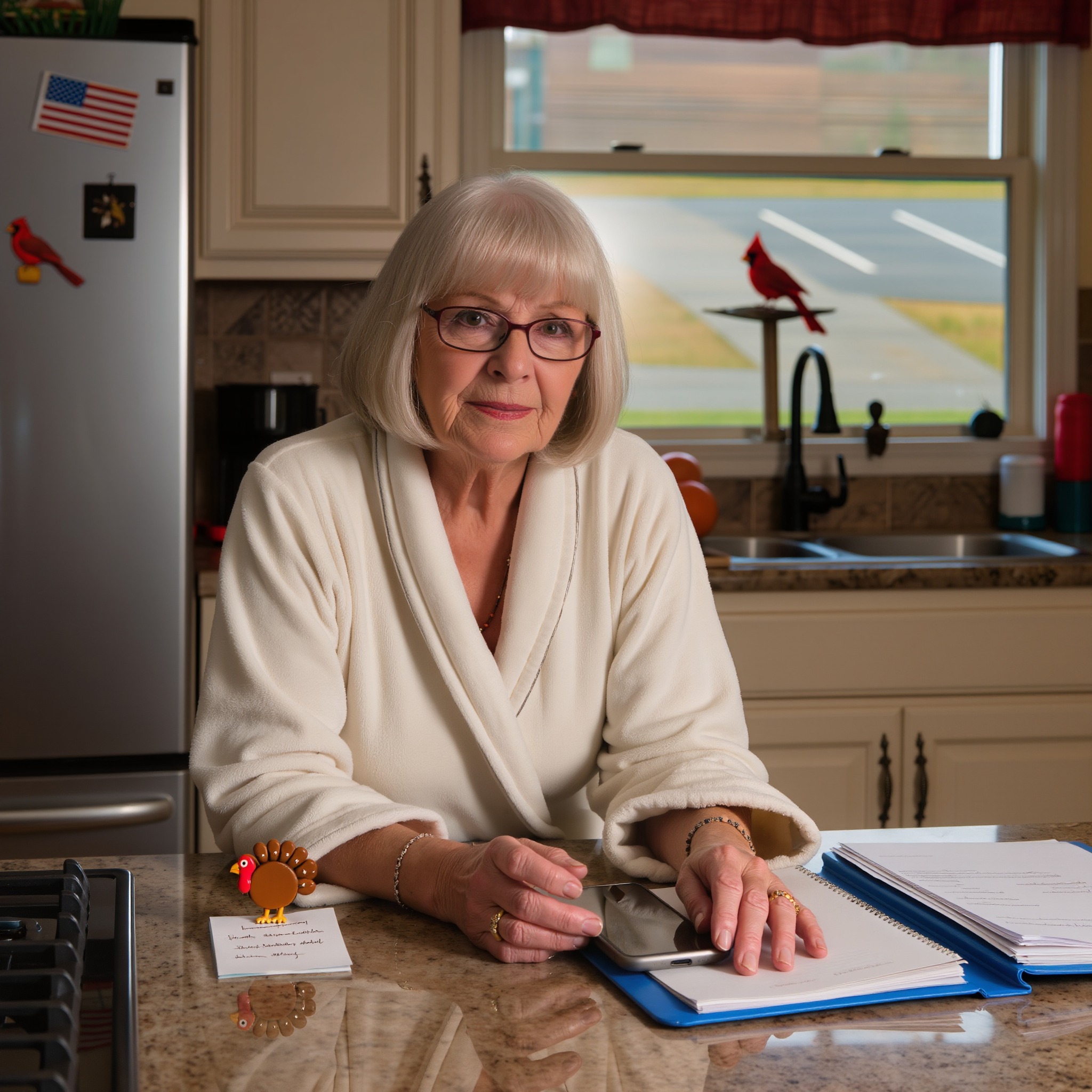
6:15 in the morning. On Thanksgiving Day.
I poured myself a cup when it was ready, added cream the way I like it, and carried it over to the kitchen table. I sat down in my usual chair, the one facing the window where I could see the bird feeder in the backyard.
A cardinal landed on it as I watched, bright red against the pale morning sky. It pecked at the seeds for a moment, then flew away.
I sipped my coffee slowly, letting the warmth spread through me. And for the first time in a very long time, I let myself think clearly—really, truly clearly—not about what I should feel, or what a good mother would do, or how I should react to keep the peace.
Just what was actually true.
And the truth was this: I was sitting alone in a house on Thanksgiving morning, drinking coffee I’d made myself, after my son and his family had flown to Hawaii without telling me. They’d left a note—not made a phone call, not invited me, not even had the decency to tell me to my face. Just a note.
I set my coffee cup down and looked around the kitchen at the refrigerator I’d bought when they said their old one wasn’t big enough. At the new curtains I’d sewn because Amanda wanted something more modern. At the table where I’d shared hundreds of meals, always making sure everyone else had seconds before I took any for myself.
And sitting there in that silent house with that note on the counter and an empty driveway outside, something inside me shifted.
I didn’t cry.
I just started thinking.
Sitting there with my coffee, my mind drifted back—not to escape what had just happened, but to understand how I’d arrived at this moment. It started three years ago when my husband Harold passed away. We’d been married for forty-eight years. He went peacefully in his sleep, which everyone said was a blessing.
And maybe it was. But peaceful or not, losing him left a hole in my life that I didn’t know how to fill. Our little house, the one we’d bought when Michael was just a baby, suddenly felt too big and too empty all at once.
I remember standing in our bedroom a few weeks after the funeral, looking at Harold’s side of the closet—his shirts still hung there, pressed and waiting. I couldn’t bring myself to touch them yet.
That’s when Michael showed up.
He’d been checking on me regularly, calling every day, stopping by with groceries I hadn’t asked for. At first, I was grateful. It felt good to know someone cared, that I wasn’t completely alone in the world.
One evening, he sat me down at my kitchen table, the same table where Harold and I had shared thousands of meals.
“Mom,” he said, his voice gentle, concerned, “I’ve been thinking. You shouldn’t be alone right now. It’s not healthy.”
I told him I was managing just fine—and I was. Grief is hard, but I’d learned over the years that being alone and being lonely are two different things.
But Michael persisted.
“Amanda and I have been talking. We have that extra room downstairs. The kids would love having you closer. And honestly, Mom, we could use your help. Amanda’s working full-time now, and childcare is so expensive.”
The way he said it made it sound like we’d both be helping each other, like it was a partnership.
“You could stay in your house,” he continued. “But wouldn’t it be nice to wake up to the sound of the grandkids, to have family around?”
When he put it that way, how could I say no?
I thought about those quiet mornings in my empty house, making coffee for one, eating dinner alone while the television hummed in the background. The idea of being surrounded by life again—by laughter and noise and purpose—felt like exactly what I needed.
So I said yes.