

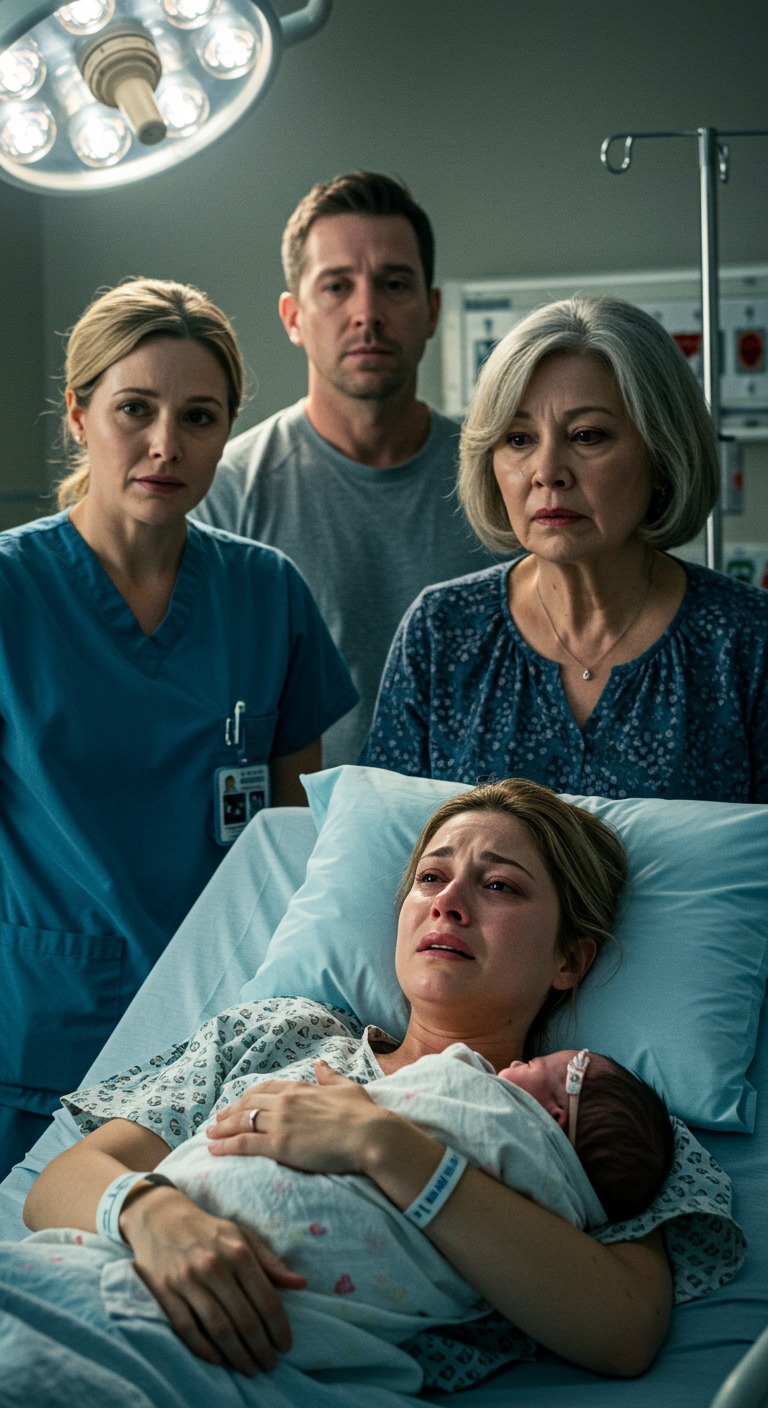
In the delivery room, my mother-in-law said, her voice cold and clear, “If it’s a girl, leave her. We only keep boys in this family.” My husband, the man I had trusted with my life, replied, “Don’t worry. I already signed the papers.” I was paralyzed under anesthesia, a silent witness to my own nightmare. I said nothing. But when I opened my eyes, my newborn daughter was safe in my arms. And a nurse leaned in and whispered, “Your nine-year-old son recorded everything they said while you were unconscious. He saved her.”
Chapter 1: A House Built on Silence
I grew up never knowing what a real family looked like. Bounced from one foster home to another, I learned early not to expect much from people. I learned to be quiet, to take up as little space as possible, and to tell myself that someday, when I had a family of my own, things would be different. It would be safe. It would be loving. It would be real.
That dream began to feel possible when I met Ryan. He was older, confident, and disarmingly charming. He listened to me, truly listened, in a way no one ever had before. I was twenty, working nights at a diner, barely affording the rent on a tiny one-bedroom apartment. Ryan would wait for me after every shift, sometimes with a single, perfect rose, sometimes just with that easy smile that made me feel like I finally mattered.
We married a year later. Looking back, I wish I had listened to the quiet, cautious voice in my head—the one that whispered warnings every time he snapped at a waitress or dismissed something I said with a wave of his hand. But when you grow up starving for connection, even a controlling hand can feel like a steadying one.

I got pregnant with our son, Zeke, three months after the wedding. That was the first time I saw the man behind the charming mask. He had no patience for morning sickness, no interest in doctor’s appointments. When I cried over swollen ankles and aching back pain, he called me “dramatic.” But when Zeke was born, a perfect, healthy boy, everything changed—for a while. Ryan seemed proud. He posted photos on social media, calling me his “warrior.” For a fleeting moment, I thought my dream had come true.
Then his mother, Dalia, moved in. She arrived with two suitcases and a stare as cold and hard as polished granite. She said she was there to “help,” but within a week, she had taken over my kitchen, changed how Zeke was fed, and informed me that I was holding my own son wrong. She never raised her voice; she didn’t have to. Every word she spoke was coated in a thin veneer of superiority, every glance a quiet, withering judgment.
Ryan adored her. If I ever dared to voice a complaint, he would shut me down. “She knows what she’s doing,” he’d say. “She raised three boys.” If I pushed harder, he’d go silent, his disapproval a heavy, suffocating blanket, or he’d simply disappear for a day, leaving me to navigate Dalia’s icy domain alone. So, I stopped pushing.
Over the years, I learned how to live quietly in my own house. I tiptoed around Dalia’s moods. I cooked the meals she liked. I gave up trying to have friends over. I was an accessory in my own life, the vessel that had brought the next male heir into their lineage. Zeke became my entire world. He was a gentle, curious soul, always asking questions, always watching. He saw everything, especially the things I tried so desperately to hide.
When I found out I was pregnant again, a flicker of hope I hadn’t felt in years ignited inside me. Maybe this time things will be different. I secretly, desperately, wanted a girl. I imagined braiding her hair, reading her bedtime stories, showing her what real, unconditional love looked like. I told Zeke he might be getting a sister. He grinned and asked if he could help pick out her name.
But the moment Ryan found out, his mood shifted. He didn’t say much, but a cold distance grew between us. He stopped sleeping in our bed, claiming he needed to work late. Dalia became even colder, if that was possible. One night, I heard them whispering in the kitchen. I couldn’t make out the words, but I knew the tone. It was the sound of plotting, of secrets. A growing dread began to claw at me whenever I caught them looking at me with something colder than indifference, something that felt chillingly close to contempt.
By the time I was eight months pregnant, I was physically and emotionally exhausted. Zeke was the only bright light in my days. He would read stories to my belly, his small voice a comfort. Then one early morning, my water broke. The contractions came fast and hard. Ryan didn’t even help me pack a bag. Dalia complained the entire drive to the hospital that I could have waited another week, as if childbirth were an inconvenience she had to endure. At the check-in desk, Ryan handed over a stack of papers I had never seen before. The nurse looked confused but said nothing.
Zeke was supposed to stay with a neighbor, but at the last minute, he insisted on coming inside. “I forgot my drawing,” he said, clutching his hoodie. I didn’t know it then, but he had slipped his old, beat-up iPod into his pocket. As I was wheeled away towards surgery, overwhelmed and utterly alone, I had no idea that my nine-year-old son was about to save his sister’s life.
Chapter 2: The Words in the Dark

Dos chicos sin hogar se acercaron a la mesa del millonario: «Señora, ¿podríamos servirle algo de sus sobras?». El millonario levantó la vista y se sorprendió al verlos…-TNY

Millonario oyó a un niño llorar “¡mi mamá está ahí!” — al abrir, la verdad lo dejó helado…. – DIUY
¿CÓMO TIENES TUS UÑAS?

¿A qué edad aparece el llamado «olor a viejo»?

Cáncer de Huesos